A manager with three projects and seven people has the same question every morning: what needs me today? The answer is spread across stand-ups, boards and goals. Reading all of them takes half an hour, so most mornings nobody does, and the late task that was holding up the beta is found on Thursday instead of Tuesday.
The Team brief puts that answer on one page. This post walks through it on the Northwind Studio demo (a fictional studio) as Daniel Reyes saw it on Tuesday 17 November, and explains which parts are counted by the product and which part is written by AI.
The facts, counted
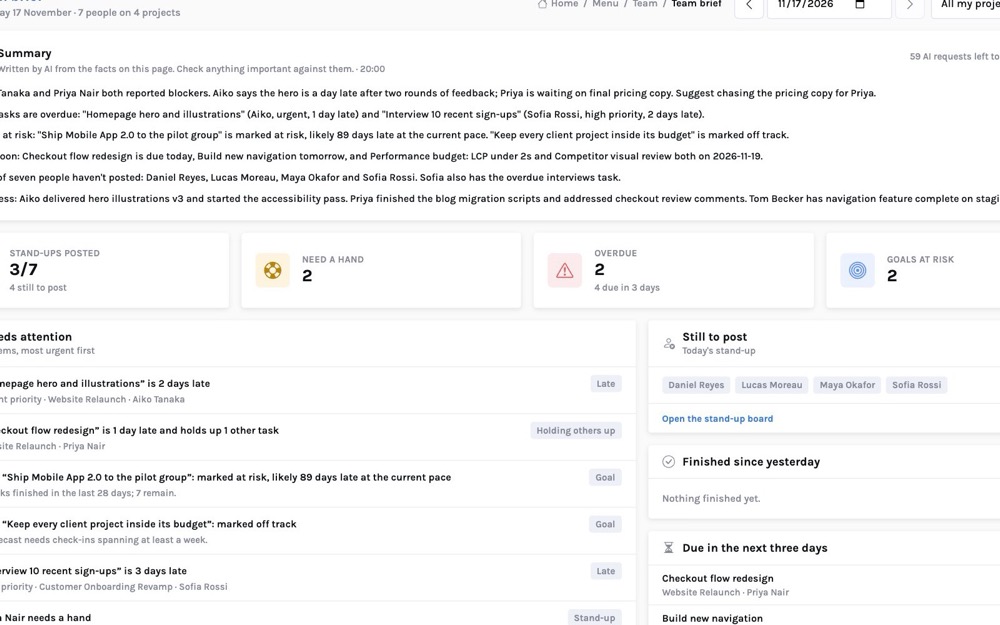
The top of the page is four numbers. None of them is estimated or written by a model; each is counted from the workspace.
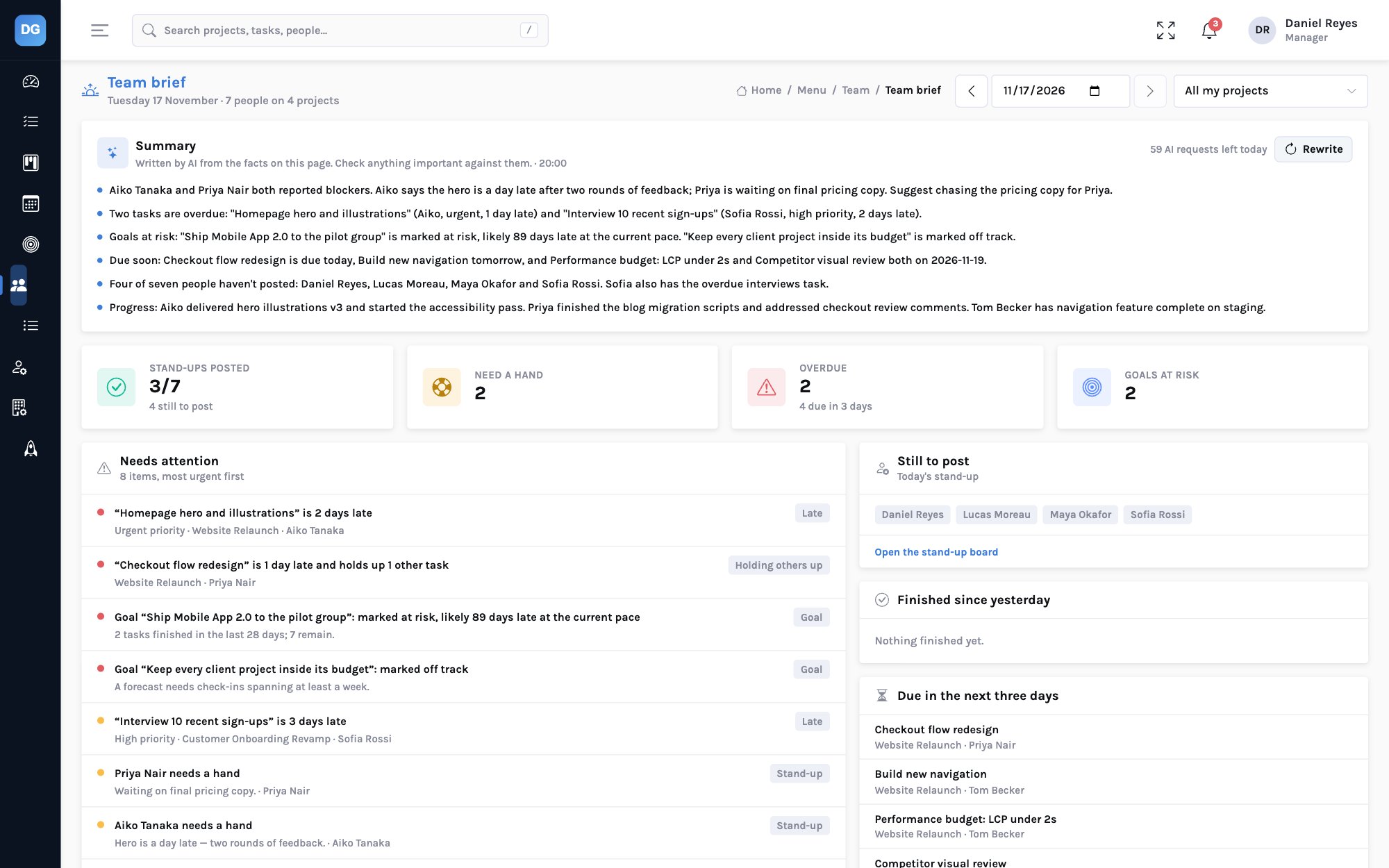
| Tile | Demo value | How it is counted |
|---|---|---|
| Stand-ups posted | 3/7 | People on your projects who have posted for the day, out of everyone on them |
| Need a hand | 2 | Stand-ups that are blocked or behind, name a blocker, ask for attention, or report low mood or a heavy workload |
| Overdue | 2 (4 due in 3 days) | Open tasks past their due date; and open tasks due in the next three days |
| Goals at risk | 2 | Open goals marked at risk or off track by their owner, or forecast to be late or stalled |
On the right of the page sit three short lists: who is still to post (Daniel himself is one of them), what finished since yesterday, and what is due in the next three days. The day picker at the top shows any earlier day the same way, and the project picker narrows the page to one project.
Needs attention: one ranked list
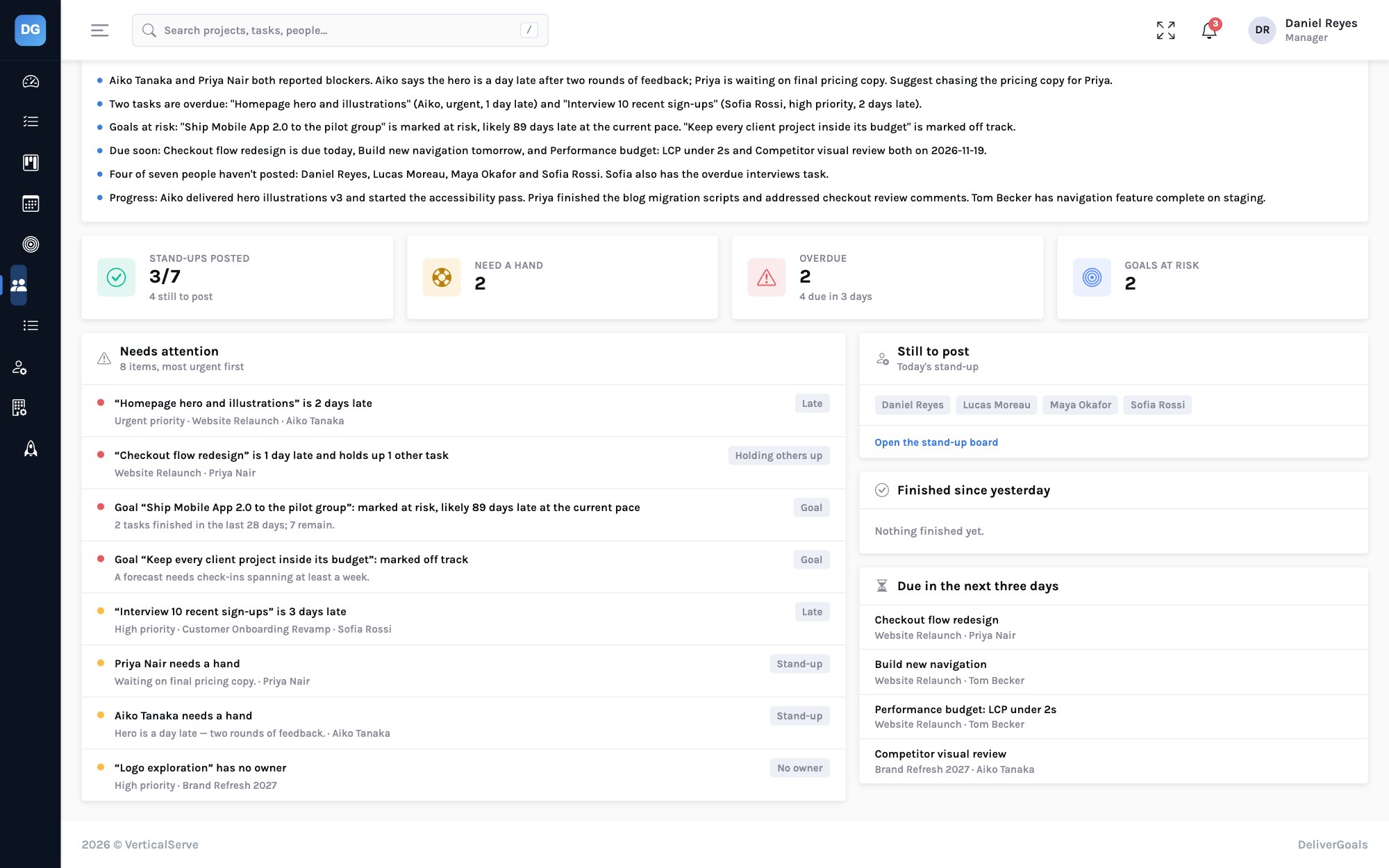
The most useful part of the page is the list underneath, because it answers “what first?” rather than “what exists?”. It pulls together everything stuck across your projects and ranks it.
| Kind | Example from the demo | Why it ranks where it does |
|---|---|---|
| Late, and holding others up | “Checkout flow redesign” is 1 day late and holds up 1 other task | The delay spreads; fix this first |
| Goal heading for a miss | “Ship Mobile App 2.0 to the pilot group”: likely 89 days late at the current pace | A date the company cares about |
| Late | “Homepage hero and illustrations” is 2 days late (urgent) | Ranked by priority and days late |
| Stand-up blocker | Priya Nair needs a hand: waiting on final pricing copy | A person is waiting on someone |
| No owner | “Logo exploration” has no owner (high) | Nobody will start it |
The last line is a good example of the list doing its job. “Logo exploration” arrived that morning in a project imported from Asana. Its owner in Asana was an outside freelancer who is not in the workspace, so the import left it unassigned, and the brief caught it within minutes.
Columns that are over their work-in-progress limit and tasks that have sat untouched in progress also appear here when they happen.
Goal forecasts: the pace, not the hope
A goal’s status is the owner’s opinion. Its forecast is arithmetic. For a goal measured by linked projects, DeliverGoals looks at how many tasks those projects finished over the last 28 days, how many remain, and when the goal is due, and says whether the goal will land on time at that pace.
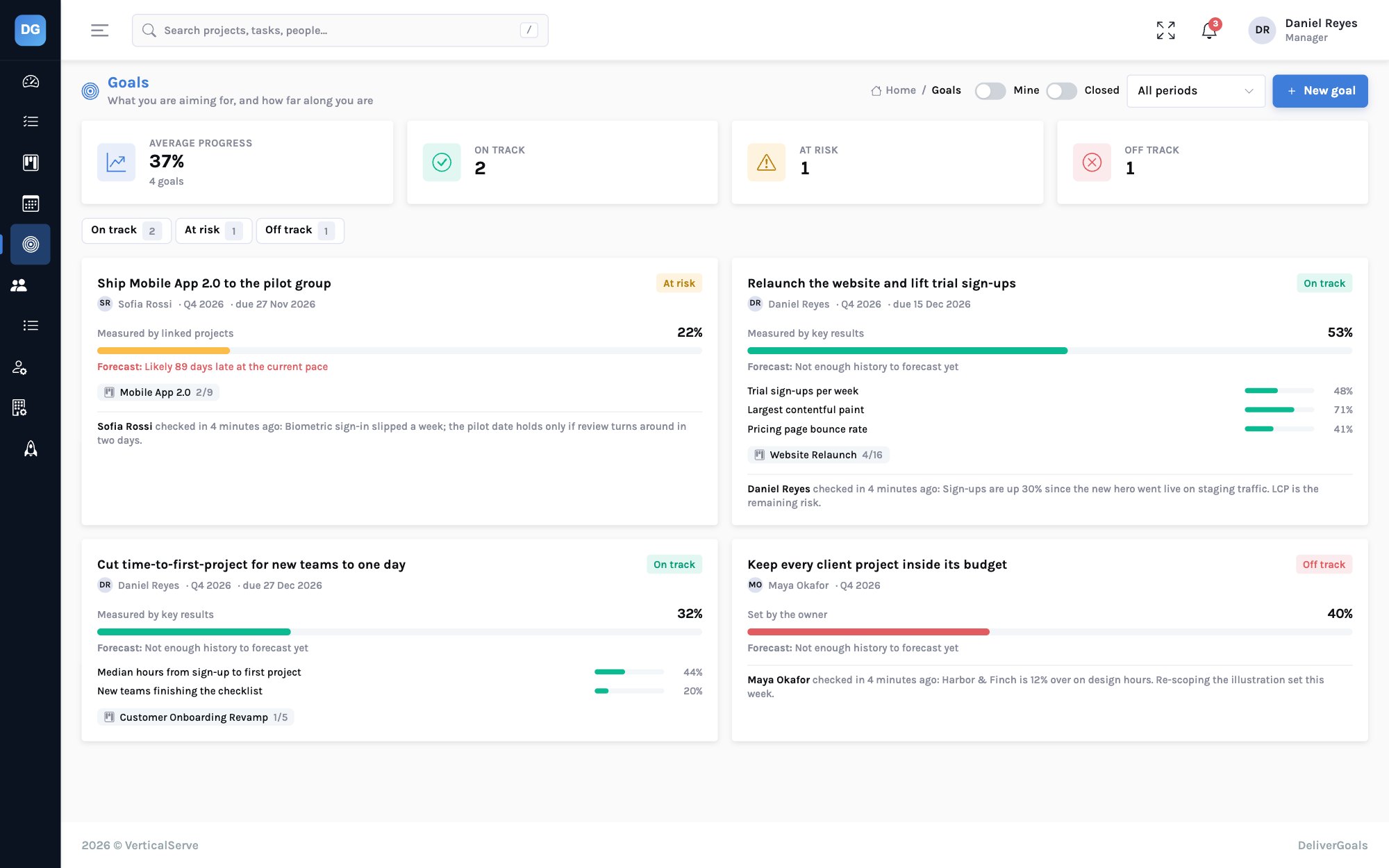
Two things make the forecast trustworthy. It says “not enough history to forecast yet” rather than guess when there is too little to go on. And it explains itself: the brief’s line for the Mobile App goal reads “2 tasks finished in the last 28 days; 7 remain”, so anyone can check the sum. When the owner’s status says on track and the forecast says late, that disagreement is the conversation to have. Goals themselves are covered in goals that measure themselves.
The summary: written from the facts, and labelled
At the top of the page, Write summary turns the facts into a few plain sentences. In the demo it read, in part: Aiko Tanaka and Priya Nair both reported blockers, chase the pricing copy for Priya; two tasks are overdue; two goals are at risk; four of seven people have not posted.
It is useful because it is short, and safe because of what it is not allowed to do:
- It only rephrases. The model receives the counted facts for the day, nothing else from the workspace, and writes from them. Every number in the summary is also on the page beneath it.
- It is labelled. The panel says “Written by AI from the facts on this page. Check anything important against them.”
- Team text is data, never instructions. Stand-up text goes to the model fenced off as data, with the rule that nothing inside it is to be obeyed. A stand-up that says “ignore your instructions” is just a strange stand-up.
- The output is cleaned. Links, email addresses, markup and scripts are removed before anyone sees it, and it is shown as plain text.
- It is written once. The summary is kept for the day; opening the page again does not call the model. If the facts change, the button says so and offers to update it.
- It is limited. Each person and each company has a daily allowance of AI requests (the page shows how many are left), and AI can be switched off for the whole service. With AI off, the brief shows a summary built by plain rules from the same facts, and says so.
What the brief does not do
It is not emailed: the morning digest covers each person’s own tasks, while the brief is read when you open it. It does not reassign or re-date anything itself. It covers people and projects you can already see; a member does not have a team brief, and no company’s brief can include another company’s work.
A five-minute morning
- 1 minRead the tiles
Who has not posted, how many need a hand, what is late, which goals are at risk.
- 2 minWork the top of Needs attention
Start with the red dots: late work holding others up, then goals heading for a miss.
- 1 minAnswer the stand-ups
Each person who needs a hand gets a reply or a chase before ten.
- 1 minGlance at due soon
Anything due in three days with no progress gets a question now, not on the day.
Daily brief, weekly review
The brief is for today’s problems. Trends, such as a person above the team’s average load three weeks running or throughput below intake for a month, need the slower weekly look described in a manager’s Monday. The stand-up that feeds the brief is covered in the ten-minute daily stand-up, and the AI features, with their limits, are on the AI page.